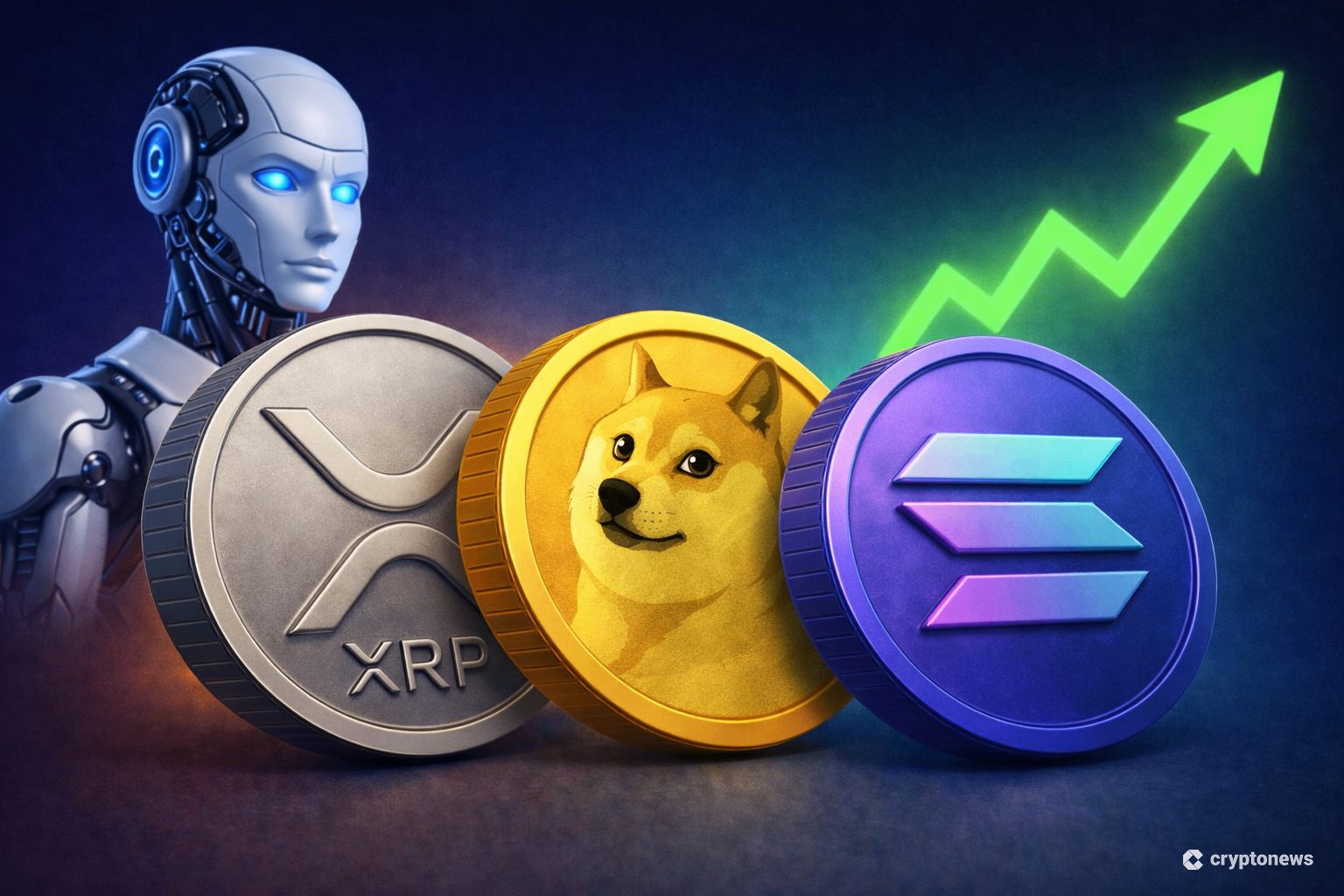
Artificial intelligence-driven forecasting models are increasingly being used to assess long-term cryptocurrency price trajectories. A structured analytical prompt applied to ChatGPT suggests that XRP, Dogecoin and Solana could potentially reach new all-time highs by the end of 2026 under favorable market conditions. XRP is projected to rise toward $8, while Dogecoin and Solana also show significant upside in modeled scenarios. The projections are based on network adoption trends, institutional integration and historical cycle behavior. Although speculative, such AI-generated outlooks reflect growing interest in data-assisted forecasting within the evolving digital asset investment landscape.
AI-Driven Price Forecasting Gains Attention
Artificial intelligence tools are rapidly becoming part of financial analysis workflows, particularly in volatile sectors such as cryptocurrency. By integrating historical market cycles, adoption metrics and macroeconomic assumptions into structured prompts, analysts can generate forward-looking scenarios.
Recent modeling conducted through ChatGPT suggests that three major digital assets — XRP, Dogecoin and Solana — may experience substantial appreciation by the end of 2026 if prevailing growth trends continue.
While such projections are not guarantees, they illustrate how AI is being used to frame long-term investment theses within the digital asset market.
XRP: Institutional Infrastructure as a Growth Catalyst
Currently trading near $1.44, XRP remains central to Ripple’s strategy of building the XRP Ledger into a globally scalable payments network. Ripple has consistently positioned XRP as a bridge asset for cross-border settlements, emphasizing speed, low transaction costs and institutional compatibility.
The XRP Ledger has also gained traction in two rapidly expanding segments: stablecoins and tokenized real-world assets. These applications aim to digitize traditional financial instruments such as bonds, commodities and fiat-backed tokens, potentially expanding blockchain utility beyond speculative trading.
Based on structured modeling inputs, ChatGPT projects that XRP could reach approximately $8 by the end of 2026. Such a move would represent more than a sixfold increase from current levels. The scenario assumes continued institutional integration, regulatory clarity and broader adoption of blockchain-based settlement systems.
However, XRP’s trajectory remains sensitive to regulatory developments and competitive payment networks. Institutional credibility could accelerate growth, but setbacks in legal or policy frameworks may temper momentum.
Dogecoin: From Meme Asset to Market Participant
Dogecoin, long associated with retail enthusiasm and social media-driven rallies, has gradually developed a more structured ecosystem. While its origin was satirical, the asset has maintained liquidity depth and brand recognition that few digital tokens achieve.
AI-generated projections suggest that if speculative cycles reemerge alongside expanding utility — such as integration into payment or decentralized finance platforms — Dogecoin could revisit and potentially surpass previous highs by 2026.
Historically, Dogecoin has exhibited exponential price expansions during bullish crypto cycles. However, its valuation remains heavily sentiment-dependent. Unlike infrastructure-oriented tokens, its long-term growth thesis relies more on community adoption and transactional use than institutional settlement systems.
The AI outlook reflects pattern-based modeling rather than guaranteed structural change. As with all meme-driven assets, volatility remains pronounced.
Solana: Scalability and Ecosystem Expansion
Solana has positioned itself as a high-performance blockchain capable of processing thousands of transactions per second with comparatively low fees. Its ecosystem supports decentralized applications, non-fungible tokens and emerging Web3 services.
AI-based modeling suggests that if network stability continues improving and developer activity accelerates, Solana could achieve new all-time highs by 2026. Growth assumptions include increased decentralized finance activity, NFT adoption and institutional experimentation with high-throughput chains.
Solana’s competitive advantage lies in speed and cost efficiency. However, it operates in a crowded landscape alongside Ethereum and other smart contract platforms. Sustained technological reliability will be critical in translating theoretical throughput into durable investor confidence.
The Role of AI in Crypto Forecasting
AI-driven projections rely on structured assumptions. They analyze historical volatility cycles, adoption curves and macroeconomic liquidity conditions. However, cryptocurrency markets remain influenced by unpredictable factors, including regulatory shifts, geopolitical developments and investor psychology.
The use of AI in financial forecasting does not eliminate uncertainty. Instead, it enhances scenario modeling by integrating multiple variables simultaneously. For investors, such tools can provide directional insight rather than precise price targets.
Long-term projections, including XRP’s potential move to $8, should be interpreted within the broader context of market risk. Digital assets have historically demonstrated both exponential gains and sharp corrections within short timeframes.
Macro Conditions and Market Cycles
Cryptocurrency performance through 2026 will likely depend on global liquidity cycles, interest rate trends and institutional participation. Bullish forecasts often assume accommodative monetary conditions and renewed risk appetite.
If capital inflows into digital assets expand alongside regulatory clarity, AI-modeled upside scenarios could gain plausibility. Conversely, restrictive policy environments or sustained macroeconomic tightening could suppress growth trajectories.
Investors should therefore view AI-generated price forecasts as conditional pathways rather than predetermined outcomes.
Conclusion
The integration of artificial intelligence into cryptocurrency analysis reflects the sector’s increasing sophistication. Projections suggesting that XRP, Dogecoin and Solana may reach new all-time highs by 2026 underscore optimism about blockchain adoption and market expansion.
XRP’s institutional settlement focus, Dogecoin’s enduring retail presence and Solana’s scalability narrative each present distinct growth stories. Whether these assets achieve AI-projected targets will depend on regulatory clarity, technological execution and macroeconomic dynamics.
For investors, the appeal of such forecasts lies not in certainty but in possibility. As digital assets continue evolving, analytical tools — including AI — are becoming central to shaping long-term strategic conversations in global finance.
About Author