As Tether’s Profits Surge, Questions Mount Over Its Role in Combating Financial Crime
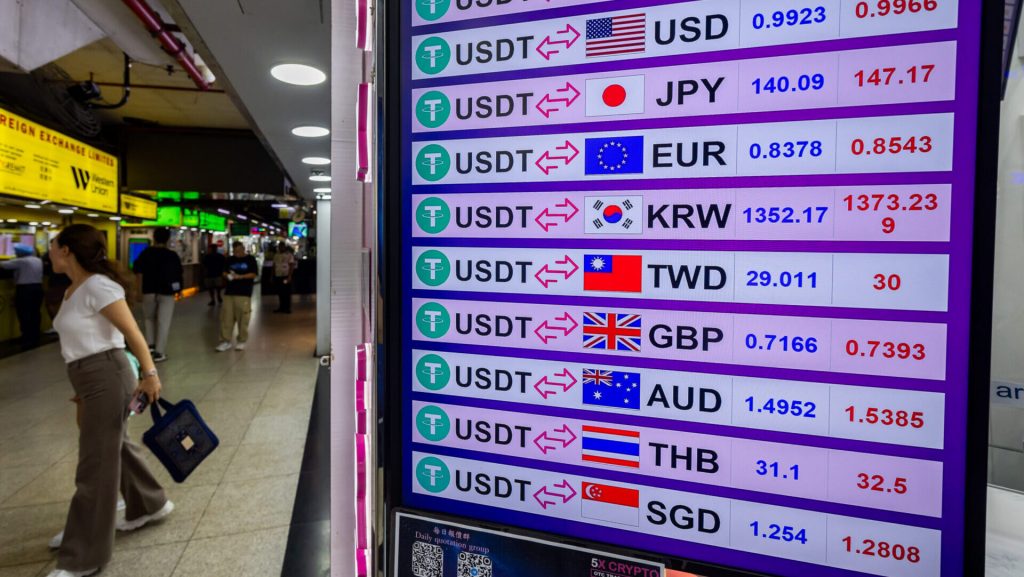
The prices of Tether (USDT) against global currencies at a cryptocurrency exchange in Hong Kong, China, on Monday, July 14, 2025. Bitcoin breached $120,000 for the first time, with investor enthusiasm showing few signs of dimming as the US House of Representatives prepares to consider key industry legislation during its "Crypto Week" starting Monday. Photographer: Paul Yeung/Bloomberg via Getty Images
Tether, the world’s largest stablecoin issuer, has emerged as one of the most profitable companies in the global cryptocurrency sector, generating billions in earnings as demand for dollar-denominated digital assets continues to climb. Yet the company’s rapid growth has reignited scrutiny over its responsibility to curb illicit financial activity flowing through the digital-asset ecosystem. While Tether maintains that it cooperates with regulators and assists law enforcement worldwide, critics argue that a corporation of its scale must adopt far more rigorous compliance standards. As stablecoins increasingly intersect with mainstream finance, the debate over Tether’s oversight practices has become impossible to ignore.
Tether’s Explosive Profitability Raises Global Attention
Tether has transformed itself from a niche crypto startup into a financial powerhouse. Its flagship product, the USDT stablecoin, now circulates in the hundreds of billions of dollars annually, facilitating transactions across decentralized platforms, exchanges, and emerging markets. The company earns substantial revenue by investing reserves backing its tokens into high-yield assets, particularly U.S. Treasury instruments.
This business model has produced exceptional profitability. Market analysts note that Tether generates earnings comparable to large financial institutions, benefiting from rising interest rates and global demand for digital dollars. Such financial strength has placed the company at the center of geopolitical and regulatory conversations about the future of payments and digital finance.
Growing Pressure on Tether’s Compliance Framework
Despite its massive growth, Tether faces persistent questions about how effectively it prevents its products from being exploited for illicit activity. Stablecoins—due to their speed, liquidity and borderless nature—have become a target for criminals seeking to evade detection through traditional banking channels.
Critics highlight several concerns: limited transparency around transactional monitoring, inconsistent reporting standards, and gaps in customer due-diligence procedures for certain platforms that integrate USDT. As regulators intensify their focus on digital-asset flows, Tether’s ability to demonstrate robust anti-money laundering (AML) and counter-terrorist financing (CTF) controls has become a central point of examination.
Company’s Defense: Cooperation and Technological Tools
Tether insists that its compliance systems match the scale of its operations. Company executives frequently emphasize that they work closely with international law-enforcement agencies, responding to data requests and freezing wallets linked to criminal behavior. They argue that blockchain technology, by design, is traceable—making illicit financial activity easier to track than in cash-based systems.
Additionally, Tether has expanded its use of blockchain analytics tools and strengthened partnerships with firms specializing in forensic tracking. The company claims that these investments reflect its commitment to maintaining trust in the stablecoin industry while balancing user privacy with regulatory obligations.
Regulators Push for Higher Standards Across the Industry
As stablecoins enter mainstream financial conversations, regulators from multiple jurisdictions are pushing for stronger accountability. Central banks and financial watchdogs fear that loosely governed digital-asset instruments could create systemic vulnerabilities, particularly in emerging markets where USDT is used as a substitute for volatile local currencies.
Calls for clearer reporting, independent audits, and real-time monitoring have grown louder. Analysts predict that global regulators may soon impose unified standards on stablecoin issuers, mirroring the scrutiny traditionally applied to banks and payment companies. In this environment, Tether’s decisions will likely influence how the entire sector evolves.
A Turning Point for Stablecoins and Global Finance
Tether sits at a crossroads. Its growth has reshaped the digital-asset economy, offering liquidity, stability, and accessibility to millions of users. But its dominance also makes it a lightning rod in broader debates about financial surveillance, consumer protection, and the integrity of global payment systems.
How the company navigates regulatory expectations—strengthening compliance while preserving the utility of its token—will determine whether stablecoins expand into mainstream finance or face restrictive oversight. Tether’s evolving role in combating financial crime may ultimately define not only its reputation but also the next chapter of the global cryptocurrency landscape.
About Author